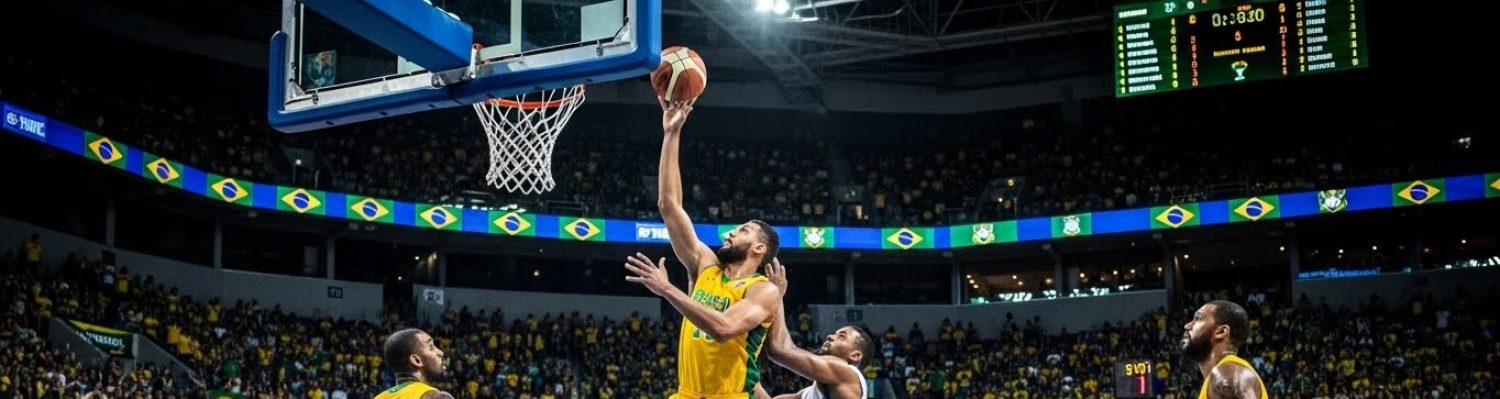
Brazilian basketball players in green-yellow jerseys during a game, with a flag and crowd in the background.
Updated: April 9, 2026
With the 2027 FIBA Basketball World Cup cycle underway, fiba Basketball Brazil faces a turning point in how the country builds success on the global stage. The national team’s fortunes hinge not only on the talent of a generation of players but on the federation’s ability to stage preparation around irregular windows, calibrate development pathways, and translate a series of qualifying games into a durable growth model for the sport. This analysis examines the structural pressures, the competitive dynamics in Group C of the Americas qualifiers, and the practical steps Brazil can take to convert potential into consistent results, both in the short term and on the World Cup horizon.
Context: Group C dynamics and the 2027 pathway
The Group C segment of the Americas qualifiers sits at the intersection of urgency and opportunity for Brazilian basketball. Brazil faces a slate of fixtures spread across domestic and regional venues, often requiring quick transitions from club duty to national-team camp and back. The scheduling cadence—split windows across a calendar year—tests continuity, player availability, and the ability to embed system-level changes that endure beyond a single cycle. The challenge is not only beating a given opponent but maintaining a coherent identity across players who operate in vastly different leagues, from Brazil’s domestic circuit to European and North American leagues. In this environment, Brazil’s coaches and administrators must lean into data-informed decisions, ensuring that each training camp and window builds toward a recognizable style of play and a sharper understanding of international competition.
Roster development and the domestic pipeline
Long-term progress hinges on a robust pipeline that can feed the national team with ready, adaptable players. Brazil’s basketball ecosystem has been steadily expanding its talent pool, but the gap between elite domestic competition and top-tier international tempos remains a critical fault line. A sustainable approach blends NBB (Nova Basketball League) development with strategic scouting across states, partnerships with European clubs that offer clear development tracks, and targeted NCAA exposure for promising players. The aim is not merely to fill a roster for the next window but to cultivate a cohort capable of absorbing advanced concepts—defensive rotations, pace control, and late-game decision-making—and translating them into real results during World Cup qualifiers and the tournament itself. The work also involves coaching continuity, standardized conditioning programs, and shared analytics that align club and country objectives rather than competing interests.
Strategy, governance, and logistics shaping the ascent
A practical blueprint for Brazil demands governance that prioritizes alignment of resources with sporting objectives. This means budgeting for high-quality training facilities, creating predictable windows that minimize player drain from club to country, and investing in coaching education and scouting. Logistics—travel, accommodation, medical support, and recovery—must be optimized so that players can stay closer to peak form during the most demanding windows. Moreover, Brazil can amplify impact by formalizing a centralized data and analytics framework: video analysis, efficiency metrics, and opponent scouting should inform decisions at both the federation and club levels. By coordinating schedules with domestic leagues and fostering partnerships with sponsors who value long-term development, Brazil can move beyond the episodic success of individual tournaments to a sustained competitive rhythm on the world stage.
Pathways to sustainable impact
The most powerful scenario for Brazil is one in which World Cup qualification becomes the catalyst for a durable cycle of improvement. That requires not only superior talent but a culture of incremental gains: codified development plans, regular national-team training camps, and an evidence-based evaluation loop that feeds back into youth programs and league design. In the near term, Brazil should emphasize three areas: (1) stabilizing a yearly cadence of national-team exposure—friendly fixtures or controlled scrimmages that mirror international tempo; (2) expanding the reach of scouting and development programs to a broader mix of states and socioeconomic backgrounds; and (3) cultivating domestic competition that resembles the speed and spacing of international play, so players arrive at qualifiers with instinctive offensive and defensive habits. If these elements come together, fiba Basketball Brazil can convert a series of isolated results into a credible, repeatable path toward the World Cup and beyond.
Actionable Takeaways
- Establish a fixed, annually recurring national-team training cycle that minimizes disruption to clubs while maximizing preparation for World Cup windows.
- Invest in a national scouting network that identifies and accelerates top Brazilian talents across states, with clear pathways to European and NCAA development environments.
- Adopt a shared analytics framework across the federation and clubs to monitor pace, efficiency, and defensive rotations, ensuring uniform decision-making criteria.
- Prioritize player welfare and recovery protocols during congested windows to reduce injuries and preserve performance quality throughout the cycle.
- Strengthen partnerships with sponsors and regional federations to fund long-term development programs, not just short-term tournament campaigns.
- Align domestic league scheduling with national-team needs to minimize scheduling conflicts and optimize player availability for key windows.