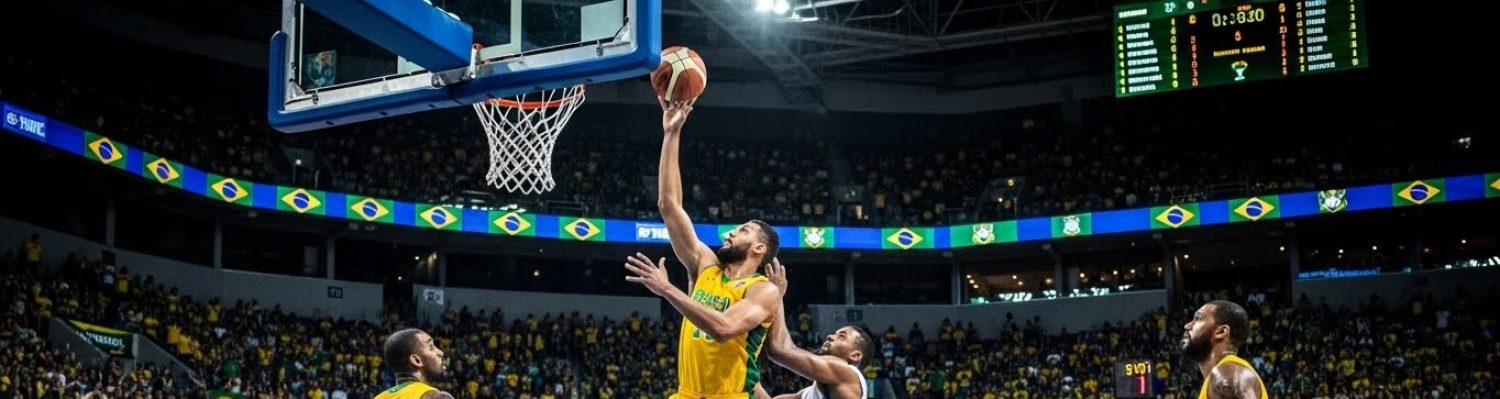
Brazilian basketball players in green-yellow jerseys during a game, with a flag and crowd in the background.
Updated: April 9, 2026
This analysis surveys how brazil Basketball Brazil is changing Brazil’s basketball landscape, connecting grassroots effort with professional pathways and international exposure. From municipal academies focused on fundamentals to elite training hubs linked to NBA franchises, the arc is less about mirroring the United States and more about building a self-sustaining ecosystem. The challenge is to translate sporadic success into durable systemic growth: more players breaking into higher levels, faster development cycles, and a domestic league that can reliably feed a national team capable of competing on the world stage. In this frame, policy choices, sponsorship priorities, and player welfare become as important as talent alone. By tracing talent pipelines, league strategies, and cross-border partnerships, this piece sketches scenarios for how Brazil can convert early signs of momentum into lasting impact for brazil Basketball Brazil.
Rising Brazilian talents and the NBA pipeline
Any assessment of the NBA’s interest in Brazil begins with a name that has resurfaced in recent seasons: Gui Santos. While the specifics of contracts and team plans can shift, the broader pattern is clear: Brazilian prospects increasingly find pathways that blend domestic training with international exposure. Scouts, coaches, and academy networks are expanding their reach, connecting Brazilian talent to established development environments in North America and Europe. The result is a more continuous exchange rather than a one-time scouting story, with players benefiting from structured coaching while clubs learn from abroad in return. This dynamic matters because it elevates expectations inside Brazil: success becomes a repeatable process rather than a matter of luck. More players are exposed to higher levels of competition earlier, which can shorten learning curves when they return to domestic leagues or move to foreign clubs. The long-term implication is a generation of players who enter the pro ranks with a clearer sense of how to adapt to different systems, styles, and pressures.
Domestic leagues and development in Brazil
The Novo Basquete Brasil (NBB) remains the centerpiece of professional basketball in Brazil, but it sits within a broader ecosystem that includes youth academies, regional leagues, and school-based programs. Clubs are increasingly stitching junior teams to senior squads, creating feeder systems that align talent development with competitive experience. This approach helps players mature alongside the league’s evolving pace, tactical complexity, and athletic demands. The domestic scene is also expanding its media footprint, with streaming services and regional broadcasts widening access to live games and highlight reels. For Brazil to cultivate sustainable growth, the domestic environment must reward long-term development—coaches, facilities, and regular competition—so players graduate from youth contexts into professional roles without a wasted year or a lost opportunity. In this setting, fan engagement and community outreach become strategic assets, not afterthoughts, because broad public interest translates into stable sponsorship and growing talent pools.
Economic and sponsorship dynamics
Basketball funding in Brazil depends on a patchwork of corporate sponsorships, government programs, and private philanthropy. Successful growth stories tend to emerge when partnerships cross borders, bringing expertise in youth development, analytics, and operations to Brazilian clubs. For scale, stakeholders must treat basketball as a systemic asset—an activity that benefits communities, offers educational value, and supports local economies. This requires accountable governance, transparent funding, and metrics that demonstrate progress in player development, competitive results, and youth participation. Sponsorship strategies that emphasize long-term impact—rather than short-term media attention—tend to produce more durable support from brands, broadcasters, and public agencies. In practice, this means formal talent pipelines, standardized coaching curricula, and shared data platforms that allow clubs to benchmark progress while preserving their autonomy and local identity.
Strategic scenarios for Brazil in global basketball
Looking ahead, Brazil faces several plausible paths. In the best-case scenario, coordinated investment in youth academies, aligned with national federation programs and NBA-affiliated training hubs, yields a steady stream of players who excel domestically and compete abroad. An intermediate trajectory might hinge on improvements in facilities, coaching quality, and talent identification, ensuring that more players reach their ceiling. A riskier scenario involves uneven development, where a handful of stars emerge but broader depth remains shallow, limiting national team options and domestic competitiveness. The crucial decision points center on how quickly Brazil can convert early momentum into structured opportunities, how effectively it retains elite prospects, and whether its domestic league remains robust enough to mirror the level of global competition.
To translate potential into outcomes, policymakers, clubs, and academies must align incentives: invest in scalable coaching, protect player welfare, and create clear pathways from youth leagues to professional circuits. With disciplined execution, Brazil could deepen its role in global basketball by producing versatile players who thrive in diverse leagues and contribute to a more competitive national program.
Actionable Takeaways
- Establish a formal Brazil-to-NBA pipeline that includes mentorship, exchange programs, and standardized development milestones across clubs.
- Expand and diversify domestic leagues to improve competition, with a particular focus on youth integration and women’s basketball to broaden the talent base.
- Prioritize coaching education and data-driven training across federations, clubs, and academies to raise on-court performance and long-term player welfare.
- Create cross-border partnerships with neighboring South American leagues for joint camps, scouting, and competitive opportunities that accelerate growth.
- Strengthen media and broadcast strategies to grow fan engagement, sponsorship value, and domestic revenue streams for sustained investment.
- Invest in analytics, research, and equipment to measure development outcomes and inform policy decisions at national and club levels.