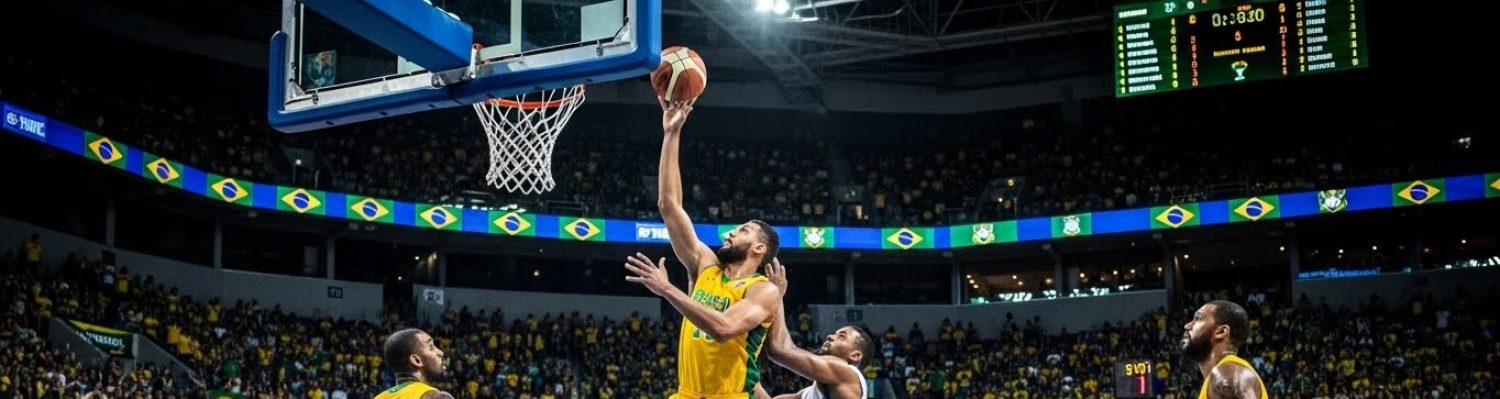
Young Brazilian basketball players training on an outdoor court with urban backdrop and coach.
Updated: April 9, 2026
In the evolving landscape of brazil Basketball Brazil, analysts watch how talent development, league reform, and international exposure intersect to shape the sport’s future in the country.
From grassroots roots to continental ambitions
Basketball in Brazil remains deeply rooted in community courts and municipal gyms, where a generation first learns to shoot under the sun or under flickering lights after school. The argument that regional pipelines matter is not new, but what has changed is the scale and tempo at which players can be identified and advanced. When clubs, schools, and local federations coordinate around a shared development framework, a teenager can progress from a neighborhood court to a national selection path in a shorter span. The contemporary pattern links informal pick-up play to structured training—shooting programs, speed and strength work, and game-situation drills—while also exposing players to higher levels of competition across the region. This shift matters for brazil Basketball Brazil because a more efficient talent pipeline translates athletic potential into basketball IQ and professional readiness. The pandemic-era disruption likewise accelerated the adoption of data-informed scouting, video analysis, and regional trials, lessons that now offer scale advantages through centralized coaching networks and standardized curricula.
Beyond the narratives of individual stars, the health of a national program depends on how well dozens of players transition through youth ranks into senior teams. Equally important is public perception: a visible path from grassroots to elite levels can sustain youth participation and attract private sponsorship. In Brazil, a growing cadre of coaches trained in modern pedagogy—focus on shot selection, decision-making, and injury prevention—helps translate raw athleticism into reliable on-court decisions. The result, if pursued consistently, is a national style that blends speed with tactical patience, enabling Brazilian teams to compete more effectively in continental tournaments and to hold their own against peers from basketball-rich nations. The broader question is whether this ecosystem can function at scale—across dozens of municipalities—without sacrificing quality at the top end of the pipeline.
The domestic league’s role in national competitiveness
The Novo Basquete Brasil, or NBB, remains the central crucible for Brazilian basketball development. When clubs invest in player development, medical staff, analytics, and modern facilities, they create a professional environment that accelerates learning and reduces injury risk. Strong domestic competition raises the floor for national-team selection; players who routinely face top-level competition sharpen their decision making and conditioning, which translates to more consistent performances in international windows. Yet the league also faces structural constraints: disparate revenue bases among clubs, uneven access to funding for facilities, and the challenge of keeping players within the domestic system during peak years when European and NBA opportunities beckon. The path forward depends on stabilizing revenue streams, expanding broadcast and streaming reach to build a larger fan base, and scheduling that minimizes fatigue while maximizing competitive tempo. If the NBB can balance financial health with developmental priorities, the national team gains depth and continuity across cycles, improving results in qualifiers and regional championships.
Strategic partnerships can be a force multiplier. Training centers housed within universities, collaboration with private sponsors for academies, and data-driven performance dashboards can help clubs measure progress and share best practices. A more robust domestic league also enables Brazil to retain promising players longer, reducing the brain drain to foreign leagues before they reach peak maturity. The practical effect is a virtuous cycle: better clubs produce better players, who in turn lift national-team performance, attracting more investment and expanding the sport’s visibility across Brazil’s diverse regions.
Talent pathways, scouting, and the influx of international training
Talent identification increasingly blends regional outreach with international exposure. Scouts and coaches emphasize early development and systematic progression, guiding players along clearly defined milestones from youth leagues to senior play. While Brazilian players have long sought opportunities abroad, a more deliberate approach to scouting—combining regional trials, school partnerships, and mentorship programs—boosts the odds that late-bloomers or players from smaller towns reach higher levels. Exposure to varied coaching philosophies and competition formats helps athletes adapt to different game tempos and tactical demands, crucial traits when Brazil competes on the world stage. The practical upshot is a generation comfortable with film study, conditioning cycles, and travel, reducing adaptation lags when transitioning to professional environments in Europe, the Americas, or domestic competition.
Private academies and municipal programs increasingly prioritize data collection: shot charts, footwork patterns, and load management. When coaches couple this information with feedback loops—regular performance reviews, video breakdowns, and individualized development plans—players gain clarity about their strengths and areas for improvement. A broader, more inclusive approach also helps diversify the talent pool by reducing barriers to entry for girls’ basketball and players from underrepresented communities, which is essential for long-term national-team resilience. The result is not a single breakthrough prodigy, but a pipeline of capable players who can contribute meaningfully across international windows and domestic campaigns.
Policy, funding, and infrastructure: the long road ahead
Infrastructure and policy are the linchpins of sustainable growth. A coherent national strategy combines targeted facility upgrades, coach education, and incentives for clubs to share resources and expertise. In practice, this means more indoor courts in regional hubs, better access to rehabilitation services, and formal coaching certification programs that align with international standards. When government support is paired with private-sector sponsorship and philanthropic fundraising, facilities and programs can endure beyond political cycles. The long-run impact is measured not by a single breakout season but by a broad uplift in participation, improved player health, and a longer horizon for national-team project planning.
Another key element is data governance: consistent metrics for talent identification, injury prevention, and performance progression. If Brazil can standardize data collection across leagues and provinces, clubs and the national program gain a reliable toolkit for decision-making. The risk lies in misaligned incentives, where short-term wins overshadow long-term capacity building. A practical remedy is to codify development milestones and publish transparent progress dashboards so stakeholders—from local clubs to national federations—can monitor outcomes and hold each other accountable. With steady funding and a clear, inclusive development blueprint, brazil Basketball Brazil can anchor its ambitions in a durable ecosystem rather than episodic success on a single court or season.
Actionable Takeaways
- Expand regionally distributed youth academies to diversify talent sources and reduce urban concentration.
- Align NBB scheduling with national-team cycles to maximize development time for top players.
- Invest in coaching education and analytics to raise the standard of play across clubs.
- Promote international exchanges and structured exposure programs for players and coaches.
- Create long-term funding mechanisms with measurable milestones for facilities and youth development.