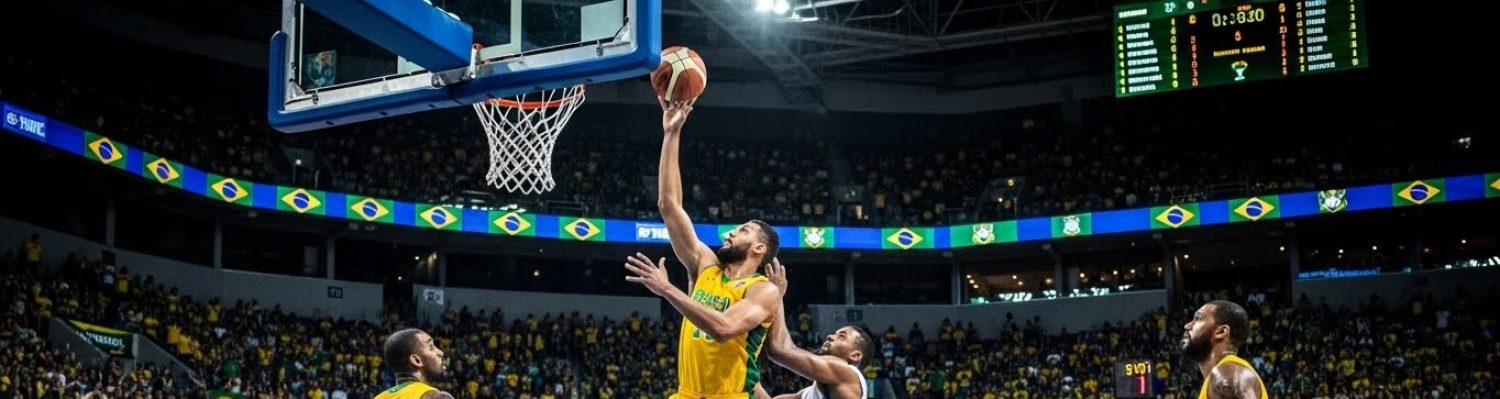
Brazilian basketball players practicing on a court, illustrating growth in san Basketball Brazil.
Updated: April 9, 2026
The ongoing conversation around san Basketball Brazil reflects more than a single season or marquee signing; it signals a threshold moment where Brazil’s hoops ecosystem must align development, competition, and exposure to compete on a broader stage. This analysis situates current trends within a longer arc—from youth programs and domestic leagues to national-team strategies—and asks what practical steps can translate into tangible gains for players and fans across the country.
Context: Brazil’s basketball ecosystem and the national program
Brazil’s basketball ecosystem has long blended regional pride with expanding professionalism, yet structural gaps have limited consistent national performance. The trajectory of the national program in recent years shows a balancing act between nurturing a rising generation and meeting the demands of a global sport. Domestically, the Novo Basquete Brasil (NBB) has broadened broadcast reach and sponsorship, but the climb from youth courts to professional rosters remains uneven across states. The current moment is less about a single breakthrough and more about governance, incentives, and the capacity to guide young players toward sustainable careers within and beyond Brazil’s borders. In this frame, the central question is not only how many players migrate abroad, but how Brazil can cultivate a system that delivers high-level talent capable of leading teams in Europe, the Americas, and on the world stage while remaining connected to the domestic ecosystem.
Leagues, talent pipelines, and the domestic development model
Much of Brazil’s potential sits at the intersection of the NBB’s growth and the broader network of state federations, clubs, and youth organizations. A robust development model requires consistent coaching education, access to facilities, and a transparent pathway from regional championships to national competitions. While the NBB has elevated professional benchmarks, disparities in funding and infrastructure persist regionally, affecting talent retention and long-term player development. The domestic system must also manage the tension between exporting talent to European leagues or the NBA and cultivating players who become anchors for Brazilian clubs and the national team. A pragmatic approach combines standardized coaching curricula, data-informed scouting, and regional investment that helps keep promising players within the domestic system during critical development years.
External attention: Brazil on the world stage and youth pathways
Brazil’s performance on the world stage increasingly depends on efficient youth-to-professional pipelines and exposure to international competition. National team programs benefit from regional talent pools connected to Europe and North America, where experience and tactical diversity can accelerate growth. Initiatives such as international training exchanges, camps, and participation in FIBA continental qualifiers create a feedback loop: better regional development translates into more competitive national squads, which in turn elevates domestic leagues’ profile and funding opportunities. The broader trend is toward an integrated system where clubs, federations, and national programs share data, align schedules with international windows, and prioritize long-term player health and development rather than short-term results alone.
Strategic scenarios: what could reshape san Basketball Brazil in the next five years
Three plausible trajectories influence the coming years. In a positive scenario, increased funding, stronger federation coordination, and expanded youth academies produce a steady stream of players who are both technically skilled and mentally prepared for high-level competition. A baseline scenario anticipates gradual improvements in coaching quality and infrastructure, with continued but uneven regional gains. A negative scenario, defined by persistent under-investment and fragmented governance, could widen gaps between well-funded urban programs and underserved regional clubs, limiting Brazil’s ability to translate talent into consistent national performance. Each path hinges on policy choices, private sponsorship, and the capacity to scale successful pilots across the country.
Actionable Takeaways
- Formalize a national coaching framework that standardizes pedagogy from youth leagues through the NBB, with regular certification and assessment cycles.
- Invest in regional training centers and affordable access to courts and equipment to broaden the talent base beyond traditional metro hubs.
- Build a data-driven scouting network that tracks players from school leagues into clubs, leveraging analytics to optimize development and reduce talent leaks.
- Coordinate the domestic calendar with international windows to maximize exposure for Brazilian players while preserving recovery and education goals.
- Encourage partnerships with universities and academies to blend athletic development with academic progression and long-term career planning.