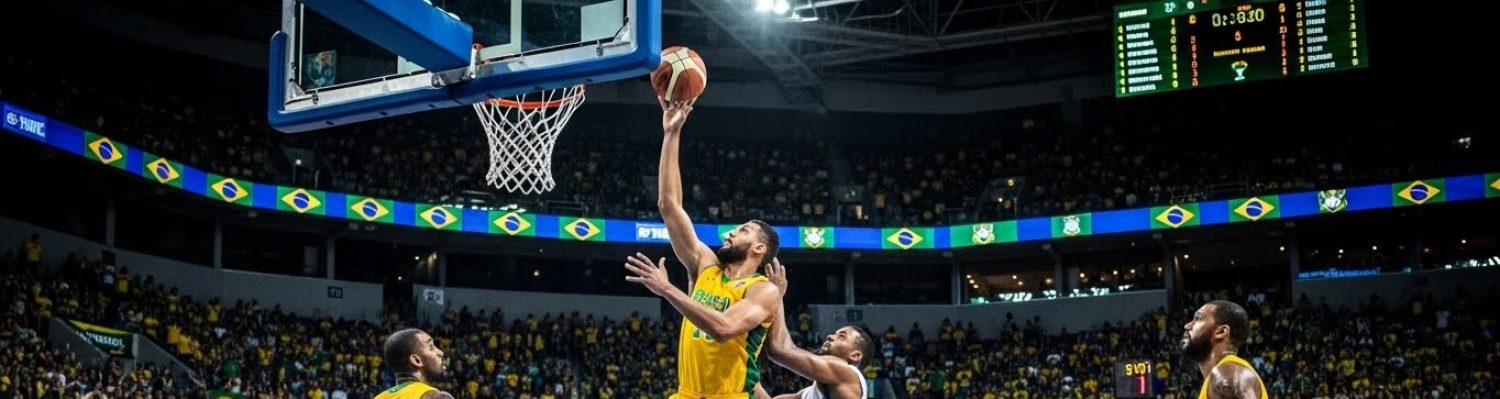

Americas Basketball Brazil: Brazil’s Qualifying Outlook
Updated: April 9, 2026
americas Basketball Brazil sits at a turning point as the qualification cycle reshapes regional competition and tests a program quintessentially Brazilian in its ambition. Across federations, clubs, and the national squad, leaders are recalibrating development pipelines, coaching methods, and talent pathways to convert early promise into sustained results on the court. The coming qualifiers will not only measure skill but also the capacity to align resources, culture, and strategy in a way that translates Brazil’s sporting identity into a competitive advantage in Americas basketball.
Context: Brazil’s standing in the Americas qualifiers
In the current landscape, Brazil competes with a mix of established rivals and rising programs across North and South America. The federation emphasizes longevity and player development, hoping to close gaps in high-usage guards and versatile wings. Success in this cycle hinges on consistency across camps, the ability to maximize the domestic league rhythm, and the integration of players with international experience. The Leo Meindl spotlight from FIBA underscores a broader shift toward guard versatility and two-way impact that Brazil is trying to institutionalize rather than rely on a single star.
Key players and development pipeline
While a single star cannot carry a program, a handful of players are illustrating the development track. Leo Meindl’s recent performances point to a cadre of guards who can pace and shoot, while forwards and centers are being groomed through youth programs in major Brazilian clubs and overseas academies. The federation has pushed to unify scouting, summer league exposure, and international training stints so players return with fresher concepts, better conditioning, and professional attitudes. The result is a Brazil that moves more decisively when the ball swings to the perimeter and that reads help-and-recover sequences with less hesitation.
Tactical trends and regional dynamics
Strategically, Brazil is leaning into pace, spacing, and three-point attack, while balancing defense and ball-screen continuity that suits international competition. The regional dynamic—where teams from Canada, the United States, Argentina, and Venezuela push for faster tempos—puts Brazil in a position where patient build-up and high-energy defense may yield more turnovers and faster counter opportunities. The domestic league’s schedule, travel demands, and short windows between camps require coaches to design flexible game plans that can travel across time zones and court conditions.
Risks and scenario planning
Brazil faces several risks that could derail progress if not managed: injury to a core guard group, attrition in the domestic league, or the challenge of converting Euroleague- and NBA-level experiences into consistent regional impact. Conversely, a best-case scenario would see the guard corps mature into a two-way unit that spaces the floor and generates efficient shot distribution, while a middle scenario would require continued improvements in shot selection and defensive discipline to avoid miscommunications in tempo.
Actionable Takeaways
- Invest in a national development calendar aligned with youth, domestic league, and international camps.
- Prioritize guard development and 3-point shooting as core strengths.
- Build a scalable playbook adaptable to travel and different arenas.
- Strengthen injury prevention and sports science integration.
- Foster partnerships with European leagues and NBA academies to accelerate experience.
- Improve data-driven scouting and video analysis for faster iteration.
Source Context
From an editorial perspective, separate confirmed facts from early speculation and revisit assumptions as new verified information appears.
Track official statements, compare independent outlets, and focus on what is confirmed versus what remains under investigation.
For practical decisions, evaluate near-term risk, likely scenarios, and timing before reacting to fast-moving headlines.
Use source quality checks: publication reputation, named attribution, publication time, and consistency across multiple reports.
Cross-check key numbers, proper names, and dates before drawing conclusions; early reporting can shift as agencies, teams, or companies release fuller context.
When claims rely on anonymous sourcing, treat them as provisional signals and wait for corroboration from official records or multiple independent outlets.
Policy, legal, and market implications often unfold in phases; a disciplined timeline view helps avoid overreacting to one headline or social snippet.
Local audience impact should be mapped by sector, region, and household effect so readers can connect macro developments to concrete daily decisions.