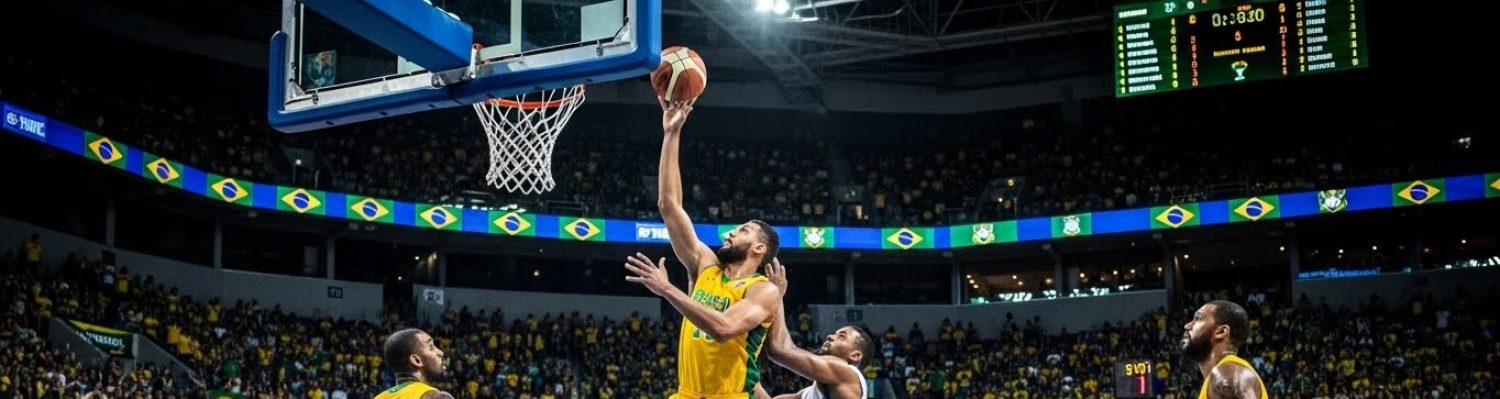
Editorial visualization of belhaven Basketball Brazil in a Brazilian basketball arena with engaged fans
Updated: April 9, 2026
In the current landscape of athletics Basketball Brazil, the sport’s progress hinges on how clubs, federations, and schools synchronize training, competition, and opportunity. This analysis draws a line from youth courts and regional tournaments to the national team’s ambitions, outlining how economic choices, coaching education, and international exposure shape the country’s basketball trajectory.
The domestic ladder: NBB and youth development
Brazil’s Novo Basquete Brasil (NBB) has grown from provincial contests into a continental product with broadcast deals and fan bases in major cities. Yet the ladder remains uneven: clubs in wealthier states can fund full-time academies, while smaller outfits juggle costs with inconsistent sponsorship. The result is a pipeline where talent often stalls at the under-22 level or moves abroad before fully maturing. A practical measure is to elevate the youth system with standardized licensing, coaching education, and a two-tier U13-U19 league that ensures regular, age-appropriate competition. The national federation’s role includes creating partnerships with schools and municipal programs to keep players in Brazil longer, linking performance data to training plans and injury prevention. The outcomes ripple into the senior team: when the domestic calendar facilitates longer development windows, the national program can call upon players who are not just physically ready, but tactically fluent in modern offenses such as ball-screening, spacing, and defensive rotations.
Brazil’s tactical identity on the world stage
Brazilian teams have historically combined athleticism with improvisation. In international play, teams that balance pace with disciplined decision-making tend to outperform. The current trajectory suggests a growing emphasis on pick-and-roll mastery, off-ball movement, and versatile defenders who can switch across positions. This tactical evolution interfaces with Brazil’s talent pipeline: players who train in well-structured youth programs tend to arrive at the senior level with a clearer understanding of spacing, counters, and communication on the floor. The challenge is sustaining this development as clubs juggle rosters with financial constraints; when teams can invest in scouting and analytics, players learn to read defenses sooner and adapt to international schemes more quickly.
Economic and logistical hurdles shaping progress
Basketball in Brazil competes for attention and funding with football and, in some regions, with other sports with entrenched local support. The economics of the NBB—ticket revenue, sponsorship, broadcast deals, and player salaries—directly influence how much time clubs can allocate to year-round training, injury prevention, and international exposure. Travel between cities, facility quality, and access to high-performance staff are not uniform, creating gaps between wealthier clubs and smaller programs. Policy decisions at the federation level—such as calendar alignment with school years, development grants, and coaching education pipelines—have cascading effects on talent retention and national-team readiness. In practical terms, stable funding paired with transparent performance metrics can convert raw athletic potential into consistent on-court performance against export-oriented leagues in Europe and North America.
Actionable Takeaways
- Strengthen a unified youth development framework across the NBB, with standardized coaching licenses and a compulsory multi-year path from U13 to the senior level.
- Build partnerships with schools and municipal programs to extend the Brazilian basketball pipeline, keeping more players in-country during crucial development years.
- Invest in data analytics and sports science at the club level to track growth, identify gaps, and tailor conditioning to prevent injuries and extend careers.
- Secure stable sponsorship and broadcasting revenue to reduce turnover and fund long-term development programs instead of short-term roster moves.
- Create formal pathways for players to experience European and North American leagues while preserving a strong domestic league that serves as a competitive home base.
Source Context
These sources provide background on how contemporary coverage frames Brazil’s basketball landscape and its global context:
From an editorial perspective, separate confirmed facts from early speculation and revisit assumptions as new verified information appears.
Track official statements, compare independent outlets, and focus on what is confirmed versus what remains under investigation.
For practical decisions, evaluate near-term risk, likely scenarios, and timing before reacting to fast-moving headlines.
Use source quality checks: publication reputation, named attribution, publication time, and consistency across multiple reports.